
Why local businesses are going invisible online
AI tools now answer 'who should I hire?' with two or three names. Why established Connecticut firms get left out, and five fixes to start this month.
By Carl Keyser ·
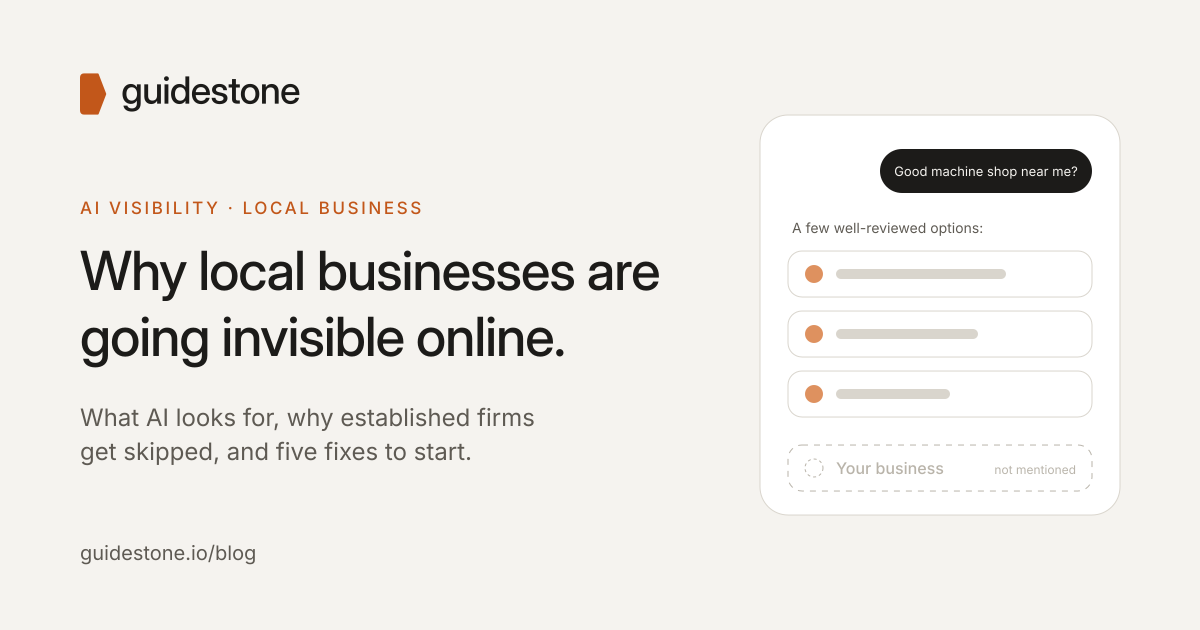
Some of the best businesses in Connecticut are disappearing from the place their next customer is looking. Their work hasn’t slipped, and neither has their reputation. What changed is how people find them.
Type “good machine shop near Waterbury, CT” into ChatGPT, Gemini or Google’s AI answer and you won’t get a page of links to sort through. You’ll get a short, confident answer naming two or three businesses. If yours isn’t one of them, that buyer may never know you exist.
I see this up close. This fall I looked at ten established manufacturers and professional firms within ten miles of our Waterbury office. Several have been in business for more than 50 years, and one for about 200 years. Nine of the ten had fewer than five Google reviews.
From ten links to three names
A traditional search results page gave everyone a chance. Even the business on the bottom half of page one got some clicks, and a buyer willing to dig could find a hidden gem.
AI assistants work differently. They read what’s available about businesses across the web, decide which ones look like the best fit, and summarize. The buyer gets a recommendation, not a list to research. That’s convenient for the buyer. For a business that isn’t in the answer, it’s a door that closes before anyone knocks.
This is no longer a fringe habit. BrightLocal’s 2026 Local Consumer Review Survey of US consumers found that 45% had used AI tools to find a local business, up from 6% the year before (BrightLocal).
This matters most for the questions that lead to real work: who to hire, who to call, who can make this part. Those are exactly the questions people now hand to AI.
Why established businesses are the ones disappearing
It’s tempting to assume the newest, flashiest companies are winning. More often, the businesses losing ground are the established ones: the CPA firm that’s been on Bank Street for decades, the family machine shop in Wolcott, the mechanical contractor every facility manager in town already knows.
They built their business on word of mouth, and it worked. But word of mouth doesn’t leave much of a trail online, and AI can only recommend what it can find and understand. Here’s what usually gets in the way:
- A thin or outdated website. A homepage, a phone number and a photo from 2012 don’t tell AI what you make, who you serve or why you’re good at it.
- Very few reviews. A shop with 40 years of happy customers and three Google reviews looks, to AI, like a shop almost nobody has heard of.
- Listings that don’t match. Different addresses, old phone numbers or a former business name across Google, the chamber directory and industry sites make it hard for AI to be sure it has the right business.
- No plain description of what you do. If your capabilities live only in your head, on a printed brochure or in a PDF nobody can search, AI has nothing to quote.
None of this says anything about the quality of the work. It’s a translation problem: the reputation is real, but it isn’t written down anywhere AI reads.
Google says much the same about its own local results. They’re based mainly on relevance, distance and prominence, and review count and rating feed into prominence (Google Business Profile Help). For its AI Overviews and AI Mode, Google says there are no special requirements beyond its usual advice: helpful, reliable content written for people (Google Search Central).
What being invisible costs you
The cost is easy to miss because it never shows up as a lost deal. It shows up as calls that never come.
- You miss the first shortlist. When a buyer starts with AI, the two or three names it gives become the companies they call. Everyone else has to work their way in later, if at all.
- Referrals get checked, and doubted. Even a warm referral now gets a quick look online. A customer who hears your name and finds almost nothing may keep looking.
- Competitors take the credit. If AI can’t find you, it recommends someone else, sometimes a company farther away or less capable, simply because their information is easier to read.
For a business that depends on a steady stream of new customers, that quiet drop adds up.
Five things you can do this month
You don’t need a new website or a big marketing budget to start showing up. Start here:
- Ask AI about yourself. Open ChatGPT or Gemini and ask the question your customers would ask, like “Who’s a good CPA in Waterbury?” or “Who does Swiss machining in Connecticut?” Note who comes up and whether you do. We ran this kind of check on our own site first; here’s what AI got wrong about us.
- Write down what you actually do. Put a clear page on your website listing your services or capabilities, the industries you serve and the towns you cover, in plain words.
- Make your listings match. Check your name, address, phone number and hours on Google, your chamber directory and any industry directories. Fix anything that’s out of date.
- Ask happy customers for reviews. Long-time customers are usually glad to help. A few honest, detailed reviews say far more than a star rating.
- Tell your story once, well. How long you’ve been in business, what you’re known for and what makes you different. If it’s true and written down, AI can repeat it.
Where Guidestone comes in
Guidestone is an AI visibility and fractional marketing firm based in Waterbury. We work with Connecticut businesses of 10 to 200 people in professional services, trades, healthcare and dental, and manufacturing, especially established firms whose reputation has always run on word of mouth.
We start by checking what AI assistants say about your business today and who they name instead. Then we fix the gaps on your website, listings and reviews so AI can read your story clearly. After that, ongoing marketing help keeps you showing up, without the cost of a full-time hire.
Find out what AI says about your business. Request a free AI Visibility Check, email carl.keyser@guidestone.io or call (860) 946-9030.